
-

-
“The Way of Great Learning lies in manifesting luminous virtue, in renewing the people, and in resting in the highest good. Only after one knows where to rest can one attain steadiness; with steadiness comes tranquility; with tranquility comes serenity; with serenity comes reflective clarity; and through such reflection, fulfillment is achieved.”
This passage outlines not merely a sequence of moral cultivation but an inward trajectory of awareness in which ethical practice and cosmic attunement are inseparable. It traces a movement from steadiness to tranquility, from serenity to lucid reflection—a gradual interior clarification through which the individual resonates with Heaven and Earth and returns to original alignment. In this sense, contemplation is not withdrawal from the world, but disciplined presence within it.
Parallel yet distinct currents developed in Daoist and Buddhist traditions. Here, transformation unfolds through the suspension of conceptual distinctions and the quieting of ego-centered perception. Zhuangzi’s notions of zuowang (“sitting in forgetfulness”) and xinzhai (“fasting of the mind”) call for relinquishing bodily and intellectual constraints so that the mind may merge with the spontaneous flow of the Dao. Zen Buddhism, through its injunction to abandon dualistic thinking—“Do not think of good; do not think of evil”—seeks direct awakening to one’s inherent nature. Where Confucian contemplation advances through gradual clarification, Daoist and Zen practices proceed through radical emptying. Yet both converge in a shared principle: the decentering of the self. Artistic creation, in this context, emerges not as assertion but as attunement—an openness through which vitality or luminous emptiness may take form.
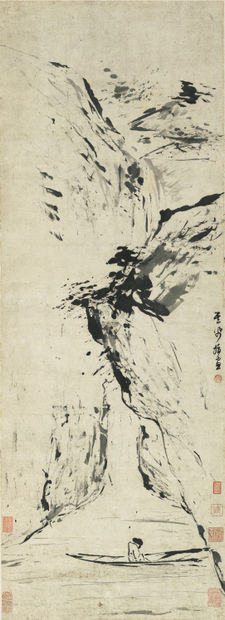
Within the philosophical horizon of classical Chinese literati painting, artists demonstrated how brush, ink, and compositional space could embody inner cultivation through distinct approaches. Qian Du (钱杜,1764–1844), following the lost Yuan masterpiece Dragon Gate: The Solitary Monk by Ni Zan (倪瓚, 1301–1374), depicts a meditative monk immersed in the forest, emphasizing subtle elegance and literati refinement. In contrast, Gao Qipei (高其佩,1660–1734) transforms similar spiritual concepts into bold, tactile gestures in his finger paintings, realizing the immediacy and spontaneity central to Zen practice.
-
-
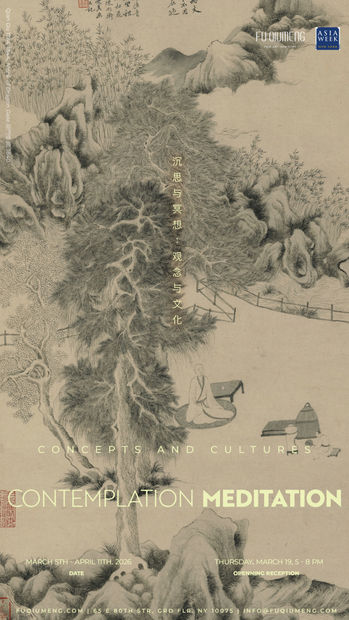
Painted in 1840, Qian Du’s hanging scroll Monk of Longmen serves as a profound visual meditation on the inner trajectories of classical Chinese thought. By depicting a solitary figure immersed in a tranquil, desolate landscape, the work gracefully evokes the Daoist and Zen ideals of zuowang (sitting in forgetfulness) and the quieting of ego-centered perception. Yet, this inward journey is not merely illustrated by the subject matter; it is deeply woven into the very rhythm of the artist's brushwork.
Qian Du decenters his own artistic ego by transcending rigid genealogical boundaries of Northern and Southern schools, and masterfully harmonizes the dynamic structural depth and light-dark contrasts of Dong Qichang's Orthodox style with the meticulous, serene elegance of the Wen School. Through this radical stylistic synthesis, Qian Du achieves a gradual interior clarification on the silk. The resulting landscape—balancing solid, undulating forms with luminous emptiness—serves not merely as a physical space, but as a visual manifestation of inner illumination and perfect alignment with the cosmic order.
-
Qian Du 錢杜 1764-1844Monk of Dragon Gate 龍門僧圖, 1840signed Qian Du, and Du, dated gengzi (1840), with three seals of the artist, qian du, yun dong guan, shu meiink on paper, hanging scroll30 1/2 x 13 in; 77.5 x 33 cm
-
Gao Qipei 高其佩 1660-1734Finger Painting: Boating by a Waterfall 指畫懸崖聽瀑signed Qipei zhihua, with one seal of the artist, peiink on paper, hanging scroll41 3/4 x 15 in; 106 x 38 cm
-
-
Parallel sensibilities emerged in Western art when artists sought to move beyond representation toward inward modes of expression. Because classical Chinese painting privileges the transmission of energy and philosophical insight over descriptive imitation, its visual logic resonates with Western movements ranging from Symbolism and Suprematism to Transcendentalism and twentieth-century abstraction. Even within the forceful gestures of American Abstract Expressionism, certain artists cultivated quieter registers: muted color fields, rhythmic structures, and atmospheric depth created spaces of sustained attention rather than dramatic spectacle. In these contexts, abstraction functions less as rupture than as concentration.
In dialogue with these traditions, the exhibition presents mid-twentieth-century American artists who approached painting as contemplative practice. Figures such as Richard Pousette-Dart, Rollin Crampton, and Sal Sirugo developed works defined by luminous circular forms, subtle tonal harmonies, and immersive spatial atmospheres. Their canvases invite inward resonance, transforming the act of viewing into an experience of heightened awareness.
-
-
Courtesy of The Richard Pousette-Dart Foundation and Pace Gallery
-
Rollin CramptonDark Harbor, circa late 1950sOil on canvas26 1/2 x 31 1/2 in; 67.3 x 80 cm
-
-
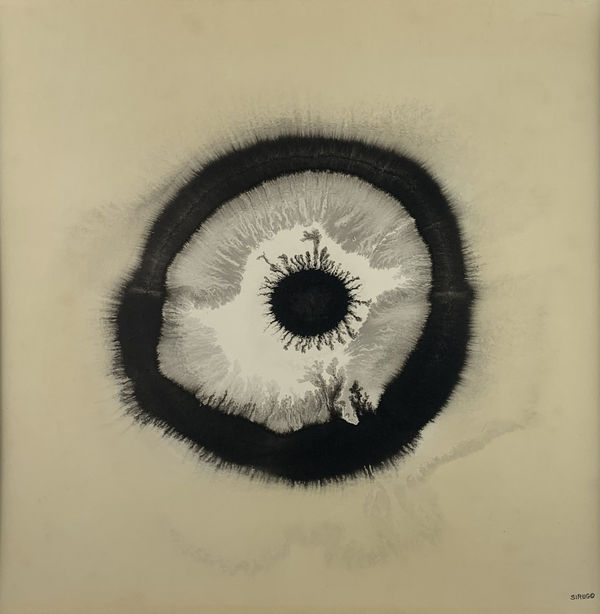
Sal Sirugo (1920-2013) was creating work by the late 1940s that represented an early and individualistic approach to the burgeoning style of Abstract Expressionism. While some of his imagery can be considered a rather early form of so-called field painting, comprising generally homogenous areas of linear elements or colors (for example, Jackson Pollock and Mark Rothko), Sirugo did not see fit to constrain himself with a signature style. He produced several distinctive visual categories: Abstractions, Landscapes, Heads, and Eyes: the latter group, containing striking variations on roughly circular themes, are emphasized in this exhibition.
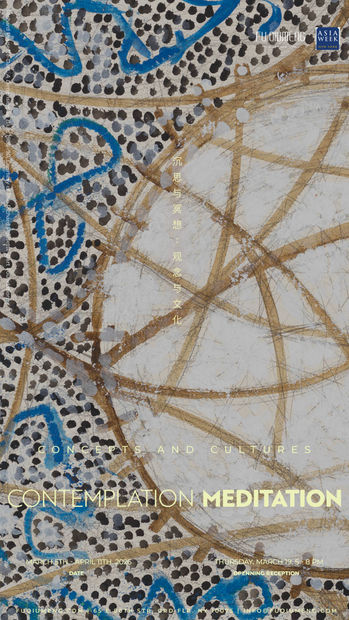
In 1953, Sirugo visited a collection of Chinese paintings in Boston. This contact with Chinese imagery and technique produced fundamental shifts in Sirugo’s methodology and conception of painting. He began working with ink and paper, noting the interplay of “the controlled and accidental fluidity of the medium” and how “the spontaneity of the ink flows ... evolve into imaginary landscapes.” Importantly, for the rest of his career, his palette was generally restricted to black and white, revealing their pictorial and emotional potential. Also, of particular significance to his output, Sirugo ignored the tendency of Abstract Expressionist painters to produce extremely large works. Instead, the typical dimensions of his paintings are remarkably modest; many are less than ten inches on each side, with some merely an inch and a half. However, Sirugo recognized the concentrated power of the small image that was also appreciated in Chinese art. He said, “There is a 17thcentury album of Chinese paintings titled “Within Small See Large”. This is how I view my work.”
The Eyes created by Sirugo apply the wandering suffusions of Chinese water-based ink toward inventive variations suggesting the human visual organ. The popular phrase “The eye is the window to the soul” comes to mind when viewers confront these works “eye to eye”. The circular motif that is so prevalent in meditative symbolic formats, such as the mandala or yin-yang, appropriately evokes a sense of imprecise yet deep thought, as one contemplates the inner – or wider – meaning of each of Sirugo’s Eyes.
-
-
Contemporary contributors extend this cross-cultural conversation. Arnold Chang, Michael Cherney, and Brandon Sadler engage East Asian materials, aesthetics, and philosophical frameworks in distinct ways. Their works do not replicate historical models but reactivate them, translating brush discipline, spatial openness, and calligraphic gesture into contemporary visual vocabularies. Alongside them, artists including C. C. Wang, Hisao Hanafusa, Liang Quan, Wang Mansheng, Zhang Xiaoli, Fung Ming Chip, and Luo Min represent modern and diasporic continuities of East Asian practice. Across these diverse trajectories, disciplined mark-making and intentional emptiness articulate reflection and presence as embodied experience.
-
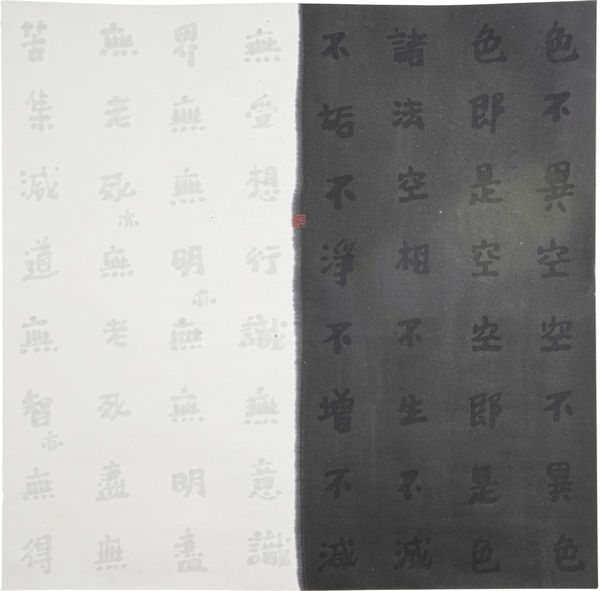
C. C. Wang Abstract Calligraphy, 1995, ink and color on paper, hanging scroll 27 x 26 in 68.6 x 66 cm
This work belongs to the abstract calligraphic works that C. C. Wang developed during the final decades of his life in New York. Trained within the classical literati tradition of Suzhou, Wang was among the last generation of artists to receive a rigorous education in poetry, calligraphy, and painting. His artistic foundation was therefore deeply rooted in the cultural and aesthetic values of Chinese literati art. After immigrating to the United States in 1949, he spent many years studying and observing at the Art Students League of New York. Living in New York—one of the major centers of twentieth-century modern art—Wang gradually encountered and reflected upon the visual language and artistic ideas emerging from movements such as Abstract Expressionism.
In his later years, Wang began to explore new possibilities within the tradition of Chinese calligraphy. Rather than adhering to the readability of written characters, he transformed the act of writing into rhythmic movements of brush and ink. Line, space, and color interact to create a visual structure that unfolds almost like musical rhythm. While these works retain the internal vitality and discipline of Chinese brush tradition, they also resonate with the freedom and expressive energy associated with modern abstraction.
This body of work reflects Wang’s unique artistic path as an immigrant artist working across cultures. Unlike many of his contemporaries in China who continued to follow established literati conventions, Wang—shaped by decades within the artistic environment of New York—developed a distinctive abstract calligraphic language that bridges classical Chinese brushwork and the visual sensibilities of modern art.
-
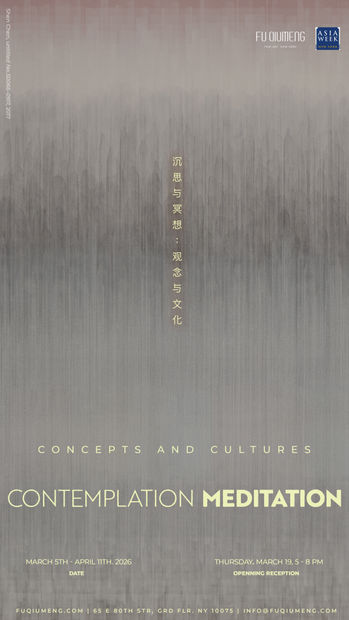
Michael CherneyShadow Curtains #5 影幔 #5ink on xuan paper, hanging scroll51 1/8 x 16 7/8 in each; 130 x 43 cm each
-
Wang ManshengGolden Age, 2010Woodblock print., Ink and Color on Paper,76 3/4 x 82 1/4 in; 195 x 209 cm
-
-
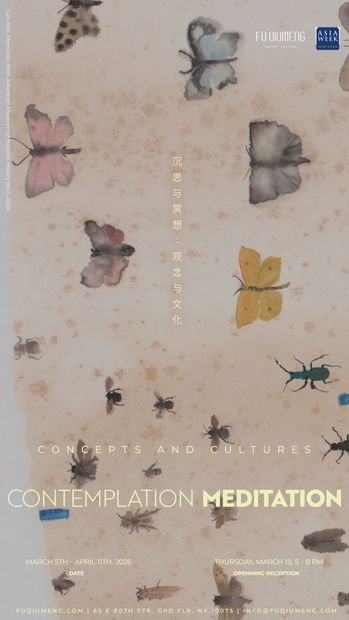
Luo Min Memories from American Museum of Natural History 美国自然历史博物馆的草虫图 No.1 , 2024 watercolor and ink on paper 18 1/8 x 50 3/4 in 46 x 129 cmThe mission of a specimen is to represent. It should be clear and precise, demonstrating every single detail of a species as a conglomeration of information. Luo Min’s specimens oppose these qualities. Her insects do not approach verisimilitude but carry fuzzy edges and curvy postures enhanced by the saturating qualities of water-based pigments. Instead of mounting the insects on a monochrome background like museum specimens, Luo populates her background with color dots and hues in pink and light brown scattered unevenly across the picture plane, generating a dreamy intimacy that softens the rigidity of the specimens and resurrects the insects. Mounting the specimens in a handscroll format also allows the static objects to be viewed in an occasional, portable, and flowing manner. Specimens are not only representations of certain species, but also vessels of the collectors’ memory, in which the animals themselves, though the process may be cruel, function as an index for a certain story. Maybe the collector went on a research trip, or maybe someone picked up the poor animal somewhere and donated it to the museum. But in either case, Luo’s handscroll emancipates viewers from being mere passive recipients of knowledge to active travelers in stories. Here, specimens not only represent biological information, but also a personal experience of traveling and feeling.
-
Brandon SadlerEquinox, 2022Ink on xuan paper 水墨纸本28 1/2 x 28 1/2 in; 72.4 x 72.4 cm
-
Tang Ke Fruit 果实, 2018 Mixed Media on Canvas 布面综合材料 39 3/8 x 43 1/4 in 100 x 109.9 cmFor Tang Ke, seasons do not end. The winter snow melts and breeds the bloom of spring, which flourishes in the summer, harvests in the fall, and withers, returns to the soil, and fertilizes the next spring. Time is thus a circle if you live with plants, which gives birth to Tang Ke’s winter melon. He plants in his garden, which allows him to get close enough to the plants, to not only be a painter who paints still life by staring at an object, but also be a farmer who lives with the object. A wintermelon, picked and placed on the table, is just one moment in the lifespan of the plant, yet for Tang, a fruit is not a stable object. It was grown from the last season, and destined to wither in the next. And when this melon is remediated into a portrait, the painting also follows such a lifespan: growing from a blank sheet of paper, and being exhibited and traded after it is done. The practice of life thus unfolds as recursive, and Tang’s melon becomes a site where time, nature, and destiny are meditated.
-
Shen Chenuntitled No.50066-0917, 2017Acrylic on Canvas48 x 42 in; 121.9 x 106.7 cm
-
-
In the seven paintings that make up his Meditation series, Arnold Chang gives up conscious preparation, composition, and color theories, and paints by allowing his hand to swim carelessly across the paper. Chang’s approach resembles a myth mentioned by great writers such as Fernando Pessoa and William Yeats, that the human mind is able to reach a certain state, when the subconscious or unconscious takes over the mind and enters a state of automatic writing, or “psychography.” Widely practiced by and associated with witchcraft, spiritualism, and Zen Buddhism, psychography has long been regarded as some sort of magic.
In theory, painting without your mind as the director can easily result in a mess; yet Chang’s image is figurative in a way: the strokes swirl and interact, working together with the colors to produce a consistent tone. However, when the eye tries to sort out a recognizable shape or pattern in the image, it finds itself lost in the strokes’ dynamics, returning to the starting point in an effortless flow. In such a viewing process, the artist transports the audience to an elongated time and space for meditation, releasing the mind and allowing the unconsciousness to move in the same motion as the painting’s creation.
-
-
-
Hanafusa’s “process paintings,” which represent a profound evolution from the artist’s earlier minimalist period, embody a mystical visual language rooted in his ecosophic worldview – a philosophy of ecological harmony or equilibrium. Concepts such as time, materiality, and process are foregrounded through the use of custom-made silver or golden aluminum paint, Hanafusa’s preferred material. Central to Hanafusa’s philosophy is the notion of uchuiden, the shared, latent memories of the cosmos that interconnect all human beings. This concept serves as the spiritual foundation of his Cosmic Inherent Memory (Uchuiden Kioku) series. Hanafusa articulates this concept with the following statement: “I didn’t do the work; Nature did it,” highlighting his collaborative approach with nature. At the methodological level, Hanafusa borrows nature’s power to express his unique understanding of materiality. In this series, water- and oil-based aluminum paints were brushed on the canvas and left to stratify under gravity. The paints flow and converge, drying with traces of bubbles and wrinkles on the canvas. This process-oriented method underscores the boundless possibilities in time and space, bridging the visible and invisible, the material and the spiritual, and reflecting his belief in the interconnectedness of all existence through the interplay of time and materiality.
-
Spanning classical ink traditions and modern abstraction, the exhibition presents works from representational landscape to non-objective form. Across cultural contexts and historical moments, a shared aspiration becomes visible: the cultivation of clarity, calm, and perceptual awareness. Through restraint, openness, and attentive structure, distinct artistic systems converge in their pursuit of stillness—not as retreat from the world, but as an intensified mode of inhabiting it.
We thank Carol Sirugo, Gracious Pine Studio, The Richard Pousette-Dart Foundation and Pace Gallery for their loans.
-
-
Rollin Crampton, Dark Harbor, circa late 1950s
-
C. C. Wang, Abstract Calligraphy, 1994
-
C. C. Wang, Abstract Calligraphy, 1995
-
Qian Du 錢杜 1764-1844, Monk of Dragon Gate 龍門僧圖, 1840
-
Gao Qipei 高其佩 1660-1734, Finger Painting: Boating by a Waterfall 指畫懸崖聽瀑
-
Arnold Chang, Meditation #2, 2026
-
Arnold Chang, Meditation #3, 2026
-
Sal Sirugo, E-81, 1973
-
Sal Sirugo, E-214, 1980
-
Sal Sirugo, E-11, 1970
-
Richard Pousette-Dart, A Dimension So Blue, 1988–90
-
Richard Pousette-Dart, Circle of Dark Light, A, 1978
-
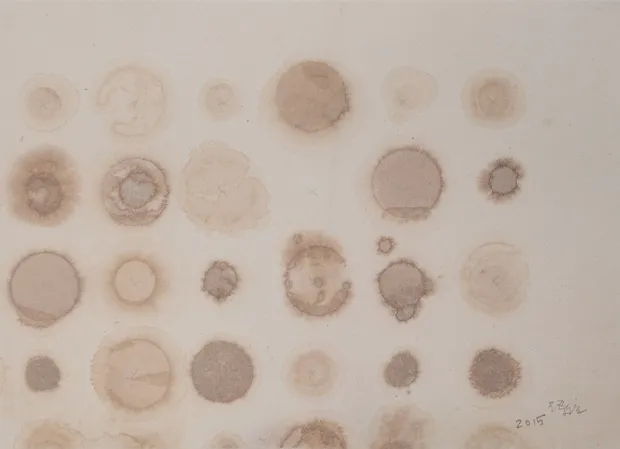
Liang Quan, Tea Stains 茶渍 1, 2015
-
Michael Cherney, Su-After Woolf, 2025
-
Luo Min, Memories from American Museum of Natural History 美国自然历史博物馆的草虫图 No.1 , 2024
-
Luo Min, Flower and Bird Atlas No.7, 2023
-
Chen Duxi, Contemplate-Telling, But Not Saying 持颐-含蓄, 2024
-
Wang Mansheng, Golden Age, 2010
-
Hisao Hanafusa, Uchuiden Kioku - QM26, 2024
-
Hisao Hanafusa, Uchuiden Kioku - QM27, 2024
-
Fung Ming Chip, 黑白心经 Section Script 01p51-6, 2010
-
Tang Ke, Fruit 果实, 2018
-
Shen Chen, untitled No.50066-0917, 2017
-
Zhang Xiaoli, Night Murmur 夜游 , 2026
-
Asia Week New York, 5 March - 11 April 2026












Join our mailing list
* denotes required fields
We will process the personal data you have supplied to communicate with you in accordance with our Privacy Policy. You can unsubscribe or change your preferences at any time by clicking the link in our emails.